
Reflecting on "Here There Are Blueberries"
A brilliant play based on a mysterious photo album from Auschwitz

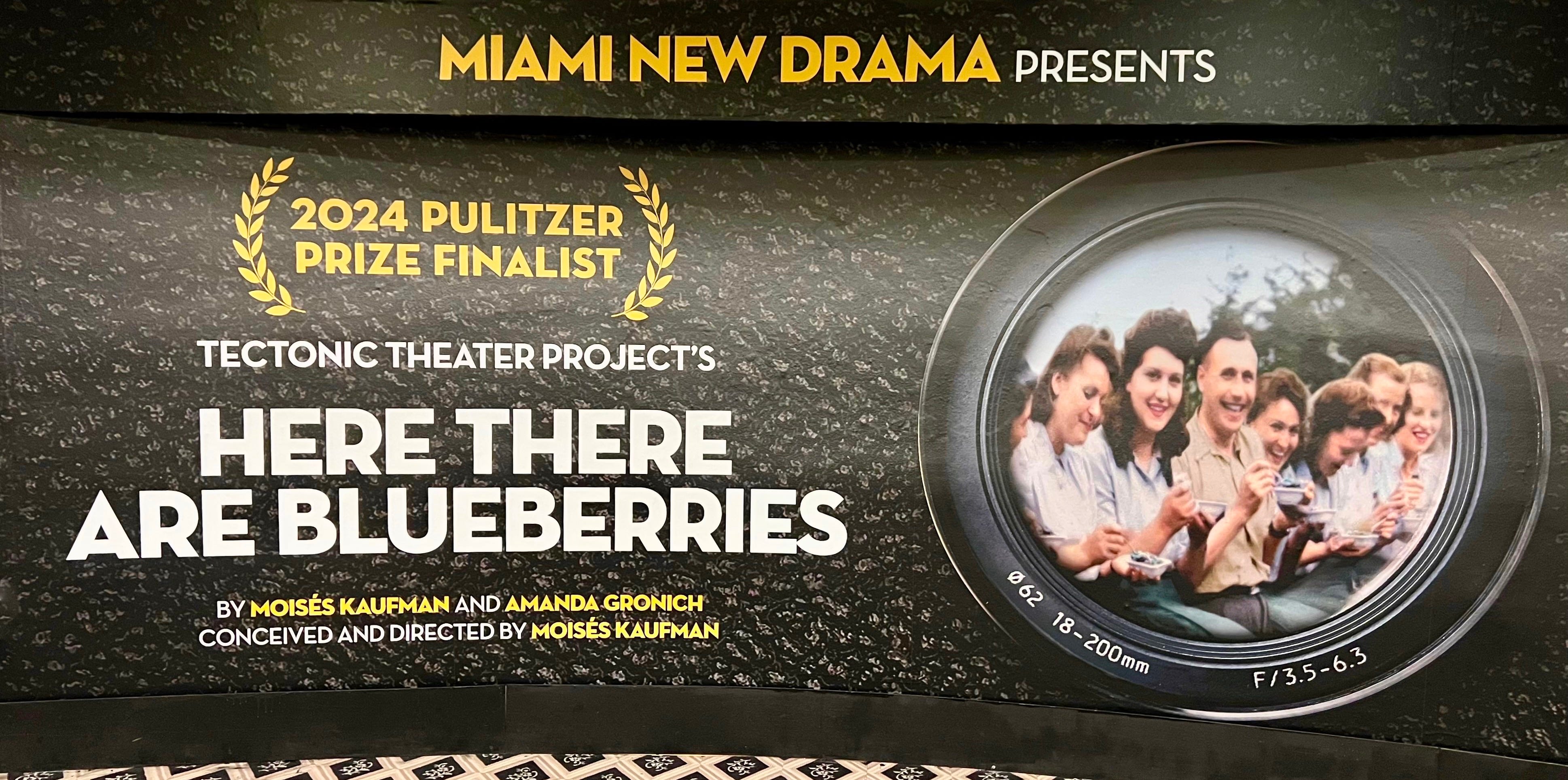
It’s their laughter—that’s what haunts.
Twelve women, dressed alike in white blouses and pleated skirts, sit on a railing outside a mountainside chalet eating blueberries. A photographer captures the joy. An accordion player serenades the celebrants, who smile for the camera, spooning the treats into their mouths, laughing. In another photograph, a uniformed man, grinning wide, stands among four others. His name is Josef Mengele.
Twenty miles from the blueberry feast—outside the camera frame—atrocities are happening at Auschwitz. The twelve women, communications workers at the camp, are taking a day trip to Solahütte, a resort where Nazis are rewarded for a job well done.
The black and white prints with deckled edges are among the pages of a water-stained photo album sent to the United States Holocaust Memorial Museum in 2007. Taken between May 1944 and January 1945, they are a sharp contrast against the backdrop of torment and mass murder of (mostly) Jews by the Nazi regime. The museum’s investigation into the album’s 116 images inspired Director Moisés Kaufman to team up with co-writer Amanda Gronich to write the Pulitzer-Prize nominated play Here There Are Blueberries.
It’s a play about the quest to identify the subjects in the photographs and decipher meaning. It’s about what you see and what you don’t see. It’s about Germany and World War II. It’s about today.
Before the show begins, I sit in my fourth-row seat, fixating on the stage, where a camera mounted on a monopod extends from a podium. It’s a 1940s Leica rangefinder, known for precision German engineering and superior lens quality. As a former newspaper and documentary photographer, I flash back to the first time I held a Leica. I hear the distinctive sound of the Leica’s shutter opening and closing, not like a click, but a shush—a tight and quiet whisper.
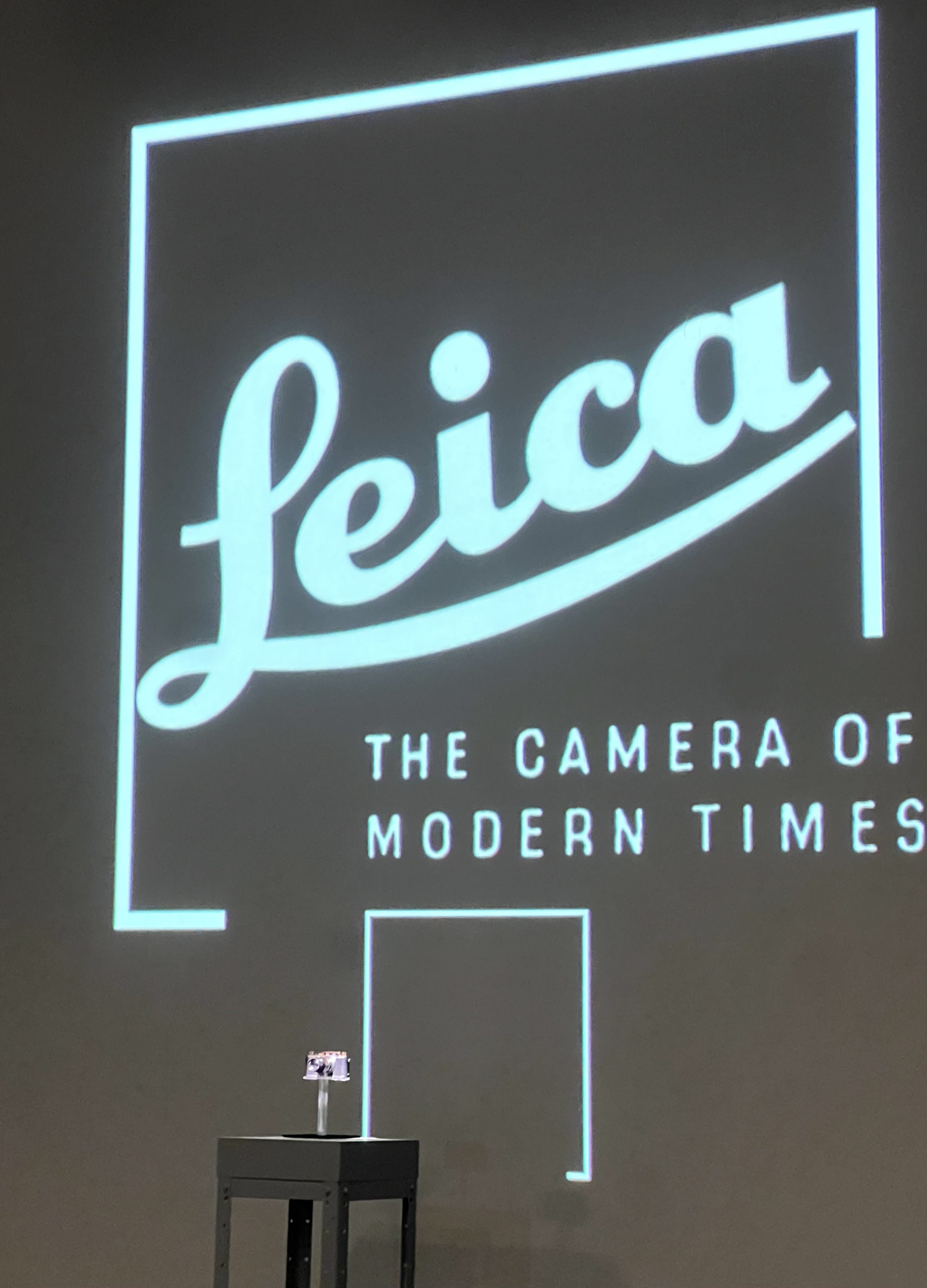
New Era of Photography
When the curtain rises, the 1940s come alive. A musician (Marrick Smith) enters. His accordion bellows with cheer. Colorful, illustrated advertisements burst onto the back wall in a tribute to the new photographic era of the 35-millimeter camera. A narrator (Folami Williams) hails its ease of use. She touts photography as a national pastime—a way to document “the pursuit of happiness.” Black and white photographs capture friends frolicking in a lake, a family of four out for a walk, and guitar-strumming musicians.
Suddenly, the mood becomes ominous. A droning sound, like an aircraft, grows loud. Then louder.
This is where the shadows meet the light.
In another photograph, adults enjoy a beach day. Their terrier curls up in the sand. My eye moves through the frame, and I feel a chill. In the background, a Nazi flag rooted in the sand waves in the summer breeze. Another image captures a row of young women—their right arms extended and aligned in a uniform fascist salute.
The museum story kicks off in a windowless room. It’s 2007, and archivists and historians are busy at work around a table. It’s a familiar world to me: a dimly lit, unglamorous working environment; squinting through loupes; studying what’s inside the frame.
The stage lights then shine on the main character, Rebecca Erbelding, lead intake archivist and curator at the museum. The light is crisp and defining, reminding me of the sharpness of the Leica lens. Rebecca, played by Delia Cunningham, receives a letter from an 87-year-old retired Lieutenant Colonel in the U.S. Army. Working in counterintelligence after WWII, he’d found the album in a Frankfurt apartment and kept it among his personal possessions. Understanding its historical significance, he donates it to the museum. In a stunning visual, the Lieutenant Colonel’s character is projected as a film negative on the back wall to portray his desired anonymity.
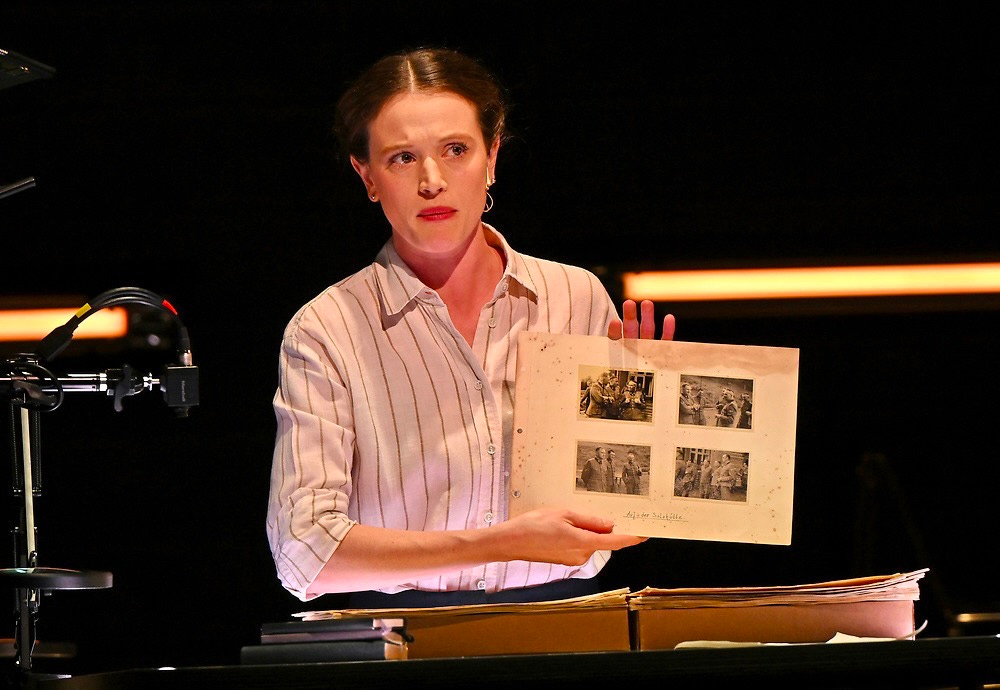
Accepting the album raises ethical questions for the curation team, whose mission is to honor the Holocaust victims. What positive purpose would it serve to show Nazis enjoying family and recreational time? Would they elevate the Nazi platform?
“Six million people don’t murder themselves,” Rebecca says, believing it is important to study the perpetrators.
Judy Cohen, the director of the photographic collection, played by Barbara Pitts McAdams, is on board. After much discussion, the museum staff agrees to widen the lens. To bear witness to the entire story, inside the frame and out.
Thus begins a team effort, in essence, to caption the photographs. To answer the 5-W questions: who, what, where, when, why.
Why? The most complex question.
Why are people smiling, relaxing, and celebrating while Jews and others deemed undesirables, are rounded up like cattle and sent to Auschwitz, where families are ripped apart, forced into labor, experimented on, starved to death, murdered?
As she studies the fragile pages, the photographs become silent characters, inviting the audience to find their voice.
The team discovers the album was compiled by Karl Höcker, a low-level bank teller who joined the Nazi party and became the righthand man to Richard Baer, the last commandant of Auschwitz. Höcker, played by Christian Pedersen, carried out the clerical duties for the campaign to exterminate Jews, including signing receipts for Zyklon B, used in the gas chamber murders. We also meet a son and grandson of Nazi doctors, along with the grandson of Rudolf Höss, the notorious commandant who built Auschwitz. All three men have identified their kin in photographs. Throughout the play, the characters talk to the audience while pondering and asking questions, as though we are participants in the story.
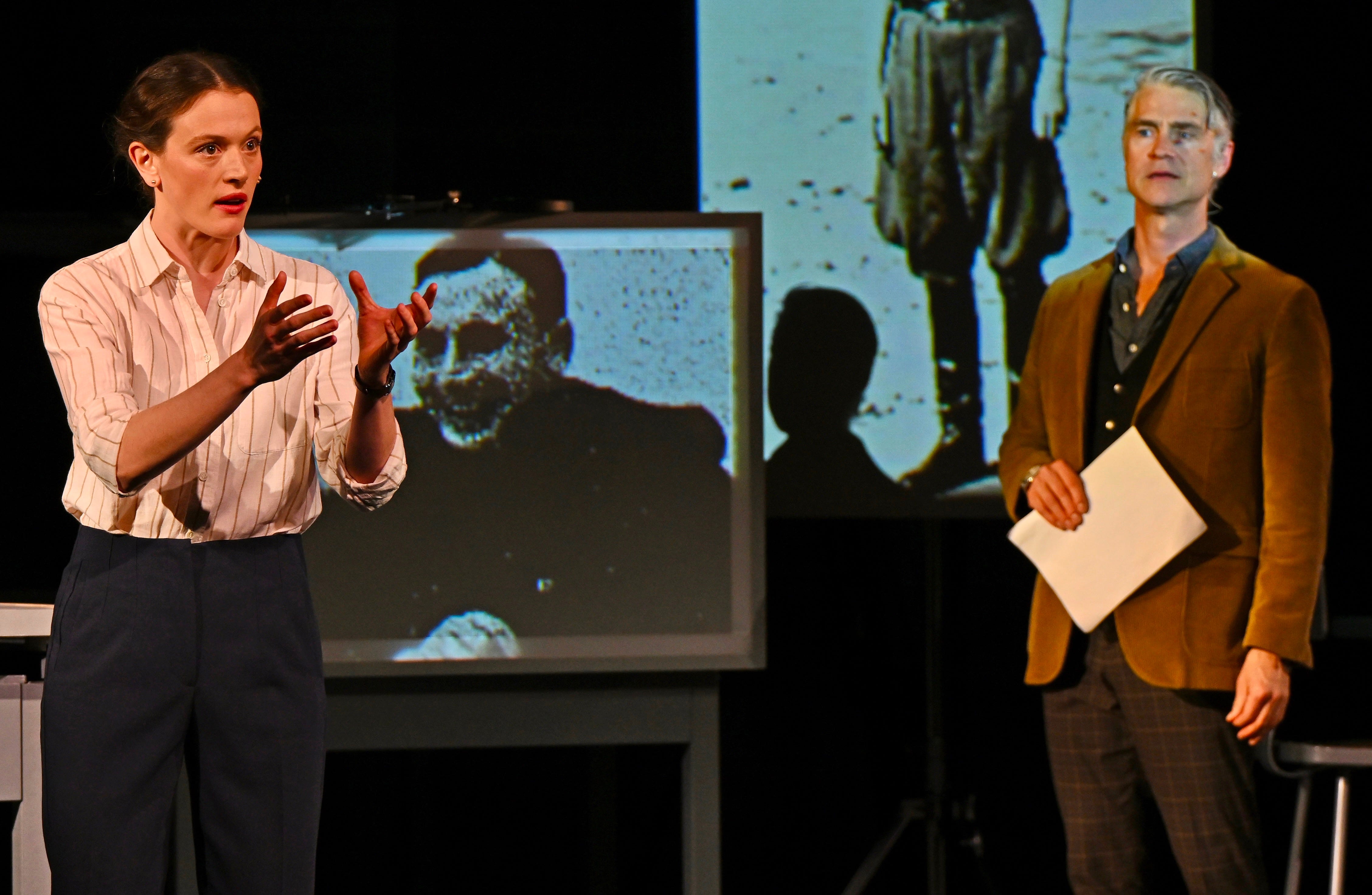
While the mystery of the 116 photographs unfolds, Rebecca presents facts with expressions of wonder and discovery but devoid of deep emotion. This is intentional. The play is not meant to preach or tell us what to think.
“It’s an act of giving a lot of trust and faith in our audience,” said actress Delia Cunningham. “It allows them to interact with the show more like an artifact you’d see presented in a museum, which can draw much richer and more expansive conclusions.”
But that’s not to say the play lacks emotion. The photographs of gleeful Nazis juxtaposed with the horrific victim photographs I hold in my mind leave me with anger, sadness, bewilderment.
I see the camera as a character, too—speaking in metaphor. Rangefinder cameras, like the Leica in the play, have two windows for the photographer. The rangefinder window is for focusing. The viewfinder is for composing the photograph and shows a wider view than what the film will capture. The photographer chooses what to leave in, what to exclude.
I think of how I frame my own photographs—and how I frame my life—and the play makes me wonder:
What do I see, and why?
What do I choose to see, and why?
I interrogate my own implicit biases, which don’t come from a place of hate, but perhaps from conditioning at a young age. But I can say the suffering I’ve witnessed with my camera has shaped and reshaped my thinking. In that former life, I used my photographs as a form of advocacy. But what about today? How often have I chosen to look the other way because it is easier? Too often.
During a presentation by the real-life Rebecca Erbelding, she said the album allows viewers to see “the little and big ways in which people are making choices to participate,” and “cross their ethical red lines.”
Hier gibt es Blaubeeren (There are blueberries here)
The photographs of the young women eating blueberries appear as the play’s emotional epicenter, asking the essential question: How do people who look like you and me become Nazis?
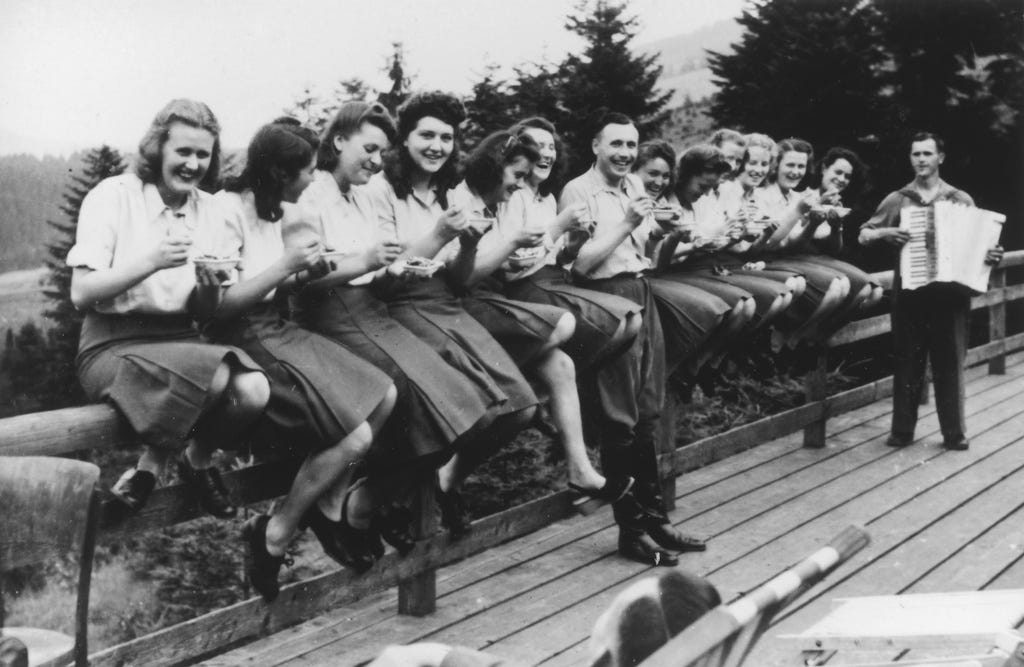
The women are communications specialists called Helferinnen (helpers), most of whom rose from the ranks of The League of German Girls, the female division of Hitler Youth, eligible to join at age 10. The character Rebecca ponders, “How much did these women really know about what was going on at the camp?”
Looking at the photographs, I think, brainwashing is a powerful tool.
Rebecca appears to acknowledge this when she puts herself in the shoes of the Helferinnen and asks, “What would I do?”
Then I ask myself a question. If the camera is witness, what is it witnessing?
Complacency? Complicity? Criminality?
To be clear, nothing in the play takes away the evil acts of Hitler and his followers. In my conversation with Delia, she talked about her Jewish identity and how she had looked at the Holocaust through the lens of victimhood. And while she mourns the Jews who were persecuted and perished—and nothing will take away from that—she embraces the play’s message. “My hope is that audiences can hold the truth of genocide and that Nazis did horrible things, but we are all capable of doing something horrible.”
The victims of those repulsive acts—of man’s inhumanity to man—are given their due voice. As the real Rebecca said, it’s important to remind viewers of “what is happening outside the frame.”
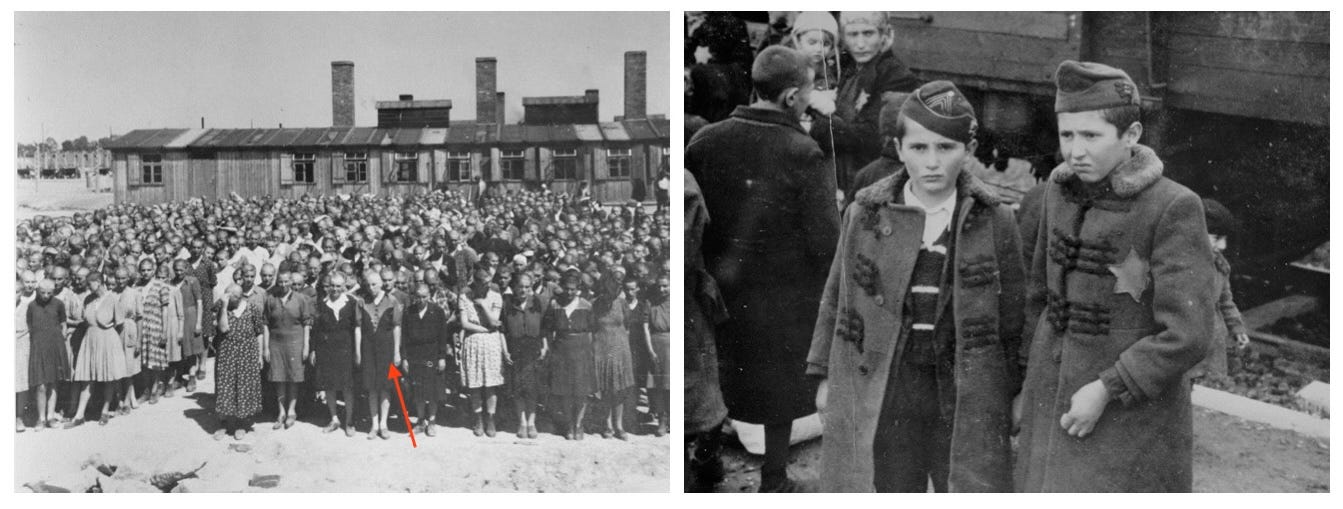
On stage, Rebecca introduces a second Auschwitz photo album, found by Holocaust survivor Lili Jacob. Lili (also played by Delia Cunningham) had found the album on a nightstand in a Nazi barrack during liberation. Pasted on the pages, she sees herself, her two brothers, and her grandparents the day they arrived at Auschwitz. The SS official on the platform had chosen Lili to work—and slaughtered her family, including her parents. Since Delia happens to be someone special in my life, I watch her every move. After Lili tells her story, she turns her back to the audience. The light fades. And that’s when I see it. It’s not in the script. Delia slowly raises her right hand to her cheek and wipes away a tear.
I think of the tears I’ve shed photographing the victims of injustices—including one that affected my life. My late husband died because of a contaminated blood scandal that killed tens of thousands of people. It involved a company that tested its pharmaceuticals on prisoners at Auschwitz. For years I considered the responsible parties as solely evil. Now, as I write about and archive this story, I find it necessary to widen my own lens and investigate the perpetrators as multi-dimensional individuals—not to justify, not to absolve, but to understand.
I don’t believe they woke up one day intending to kill, but I believe their judgement was skewed in the name of job protection, prestige, greed. It was a tragedy many years in the making.
Likewise, the rise of Nazism didn’t happen overnight. On stage, actor Marrick Smith looks into the audience and recites a quote from an Auschwitz-Birkenau museum spokesperson:
“No genocide starts with killing. Every genocide starts with words.”
“Ethical red lines” can be blurry. They can be justified. Or ignored.
Maybe that’s how Hitler turned people who looked and acted like you and me into varying degrees of human weapons.
And that’s also what haunts.
Great art, like this play, helps us to understand present moments. Faced with rising fascism, it offers us the opportunity to dig deep inside ourselves and, hopefully, to act. And that, to me, is empowering.
Cast Bios, Miami Beach Colony Theatre
Where to watch:
Seattle, through February 15; London, through February 28
Learn more:
Here There Are Blueberries Website
The Tectonic Theater Project (founded by Moisés Kaufman)
United States Holocaust Memorial Museum
Miami Living Magazine - for more on the cast and creative team
Rescue Board: The Untold Story of America’s Efforts to Save the Jews of Europe, by Rebecca Erbelding
Thanks for reading!
See you next month. ♥️
Kathy

Great, great review Cathy. Your detail, your observations all so great. I loved:
"What do I choose to see, and why?
I interrogate my own implicit biases, which don’t come from a place of hate, but perhaps from conditioning at a young age."
Wonderfully observed. How did you remember all that dialogue?